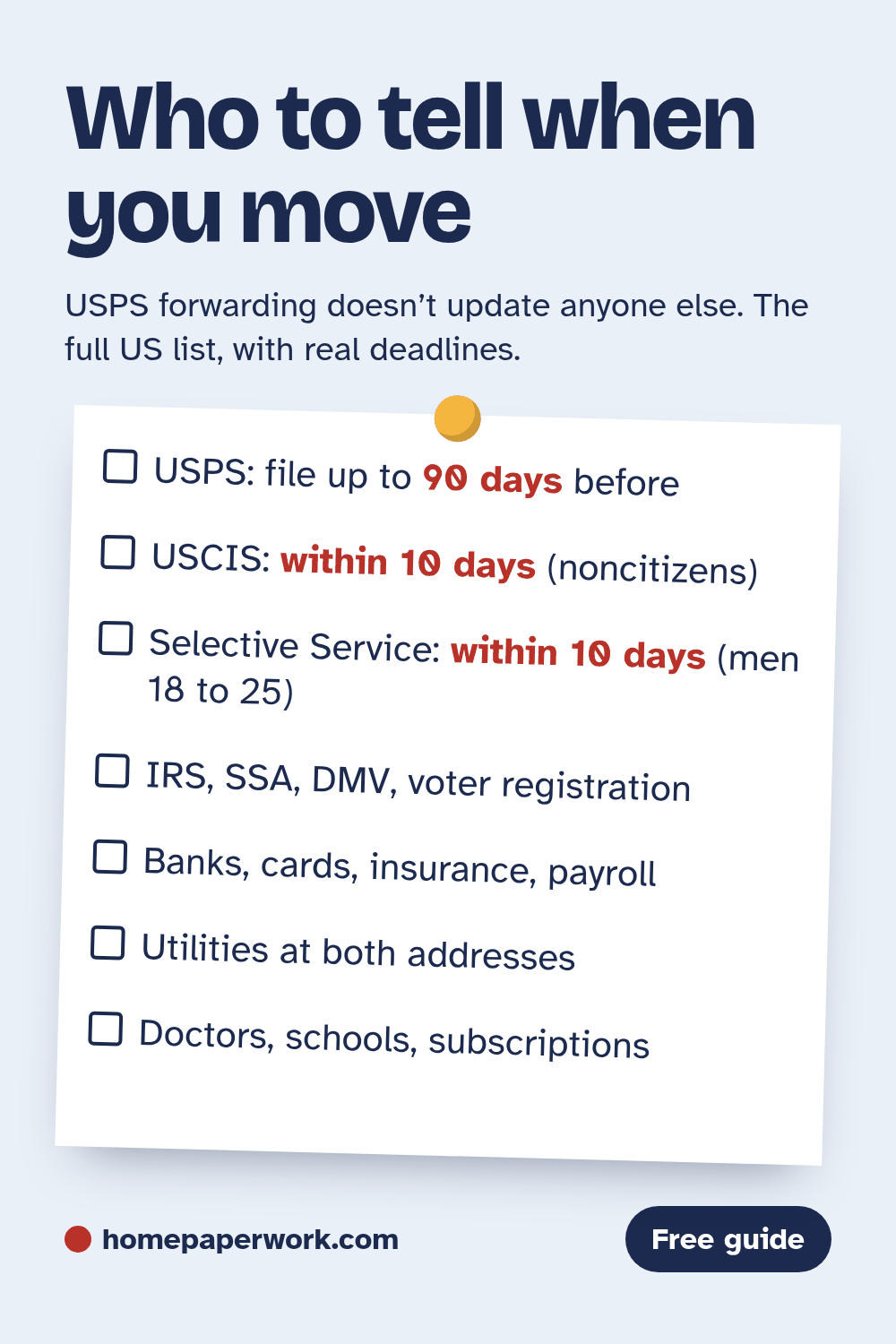
Who to tell when you move: a US change-of-address checklist
Filing a change of address with the Postal Service is the step everyone remembers. But USPS forwarding only reroutes mail for a while; it doesn't update your address with your bank, the IRS or your state. Some agencies also have deadlines as short as 10 days. Here is the full list, in the order that saves the most hassle.
Short version: file with USPS (on USPS.com, $1.25), tell the people who send you mail directly, then work through the federal and state records below within the first week. Build a dated version for your move with the free moving timeline generator.
1. USPS mail forwarding
- When: you can file up to 90 days before your move and up to 30 days after.
- Cost: $1.25 online, charged to a card whose billing address matches your old or new address, to verify your identity. You can also file in person at a Post Office with photo ID.
- How long it lasts: 12 months of standard forwarding. For a permanent move you can pay to extend it by 6, 12 or 18 months ($26, $39 or $52 when you first sign up).
- Watch out for copycat sites. USPS warns that third-party websites charge $40 or more to file a change of address, and that it no longer accepts submissions from them. Use USPS.com only.
USPS also suggests telling everyone who sends you mail at least two weeks before you move, which is what the rest of this list is for.
2. Federal agencies
| Who | Do you need to? | How |
|---|---|---|
| IRS | Yes, so refunds and letters reach you. The IRS notes that not all post offices forward government checks. | Form 8822, a signed letter, a phone call, or simply use your new address on your next return. Processing can take 4 to 6 weeks. IRS Topic 157 |
| Social Security / Medicare | If you get Social Security benefits or have Medicare. If you get neither, SSA says you don't need to report a move. | Online in your my Social Security account, or by phone at 1-800-772-1213. People who get SSI can't change it online yet; they call or visit a local office. SSA FAQ |
| USCIS | Required for noncitizens within 10 days of moving, whether or not a case is pending (A and G visa holders and visa waiver visitors are exempt). A USPS change of address does not update USCIS, and USPS won't forward USCIS mail. | Online through a USCIS account (include receipt numbers of pending cases), or Form AR-11 by mail. USCIS |
| Selective Service | Required for men aged 18 through 25, within 10 days, until January 1 of the year they turn 26. | Online form at sss.gov (you'll need your Selective Service number). |
3. State and local records
- Driver's license or state ID. Each state sets its own deadline. For example, California asks you to update your address within 10 days, and Texas within 30 days. If you move to a new state, you'll need to get that state's license; check its DMV site for the deadline. (California DMV, Texas DPS)
- Vehicle registration. Often handled by the same agency. A move to a new state generally means registering the car there.
- Voter registration. Update it whenever you move. If you've moved to a new state, you have to register there. Vote.gov links to every state's process and deadlines.
4. Money and insurance
- Banks and credit unions (checking, savings, debit cards)
- Credit card issuers, including store cards
- Loan servicers: mortgage, car loan, student loans
- Your employer's payroll or HR, so your W-2 goes to the right place
- Retirement and investment accounts
- Insurance: auto, renters or homeowners, health, life. Your address is part of your policy, and rates can change with it.
- Payment apps and online stores that save a shipping address
5. Home and everyday life
- Utilities at both addresses: stop at the old place, start at the new one (electric, gas, water, trash, internet)
- Doctors, dentist, vet and pharmacy
- Schools and childcare
- Subscriptions and memberships, including anything that ships to you
- Family, friends and anyone who sends you checks or packages
6. After the move
- Check that forwarded mail is arriving in the first week. Each letter that comes forwarded is a sender you still need to update.
- When forwarding ends, USPS returns mail to the sender for 6 months with a label showing your new address.
- Keep this list with your moving receipts. If you're tracking several due dates, the free bill calendar maker can put them on one page.
Sources
Every fact above comes from the official page linked here. We re-check them when we update the guide; the date at the top shows the last check.
- USPS: Change of Address, the basics (90/30-day window, $1.25 fee, third-party site warning)
- USPS: Standard Forward Mail & Change of Address (12 months, extended forwarding, return-to-sender period)
- USPS: Extended Mail Forwarding (prices)
- IRS Topic 157: Change your address and Form 8822
- SSA: changing your address for benefits or SSI
- USCIS: How to change your address
- Selective Service: Update your information
- California DMV and Texas DPS
- Vote.gov